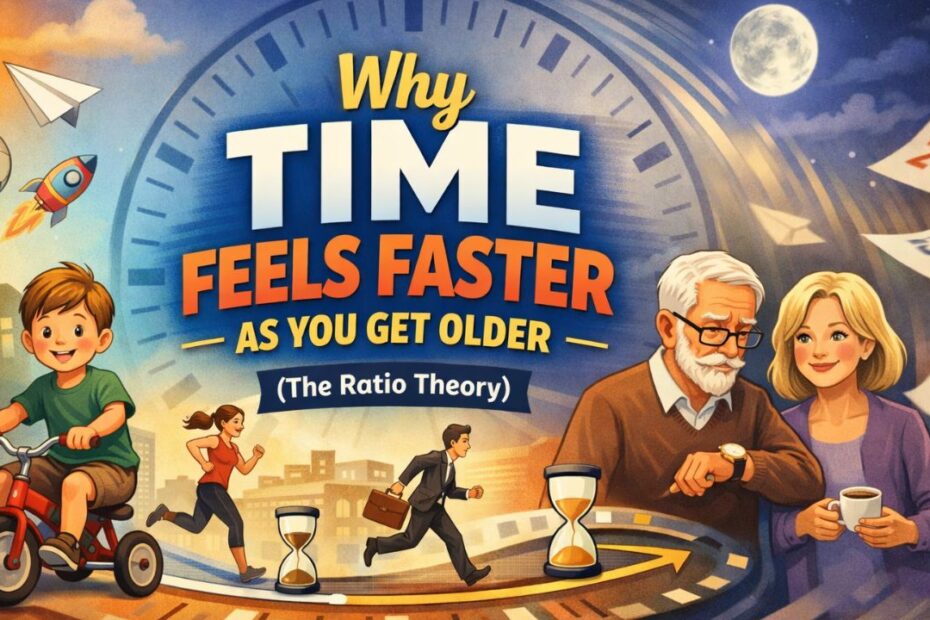
Have you ever wondered why summer breaks felt endless in childhood, while years seem to fly by now? If you’ve caught yourself asking, “Where did the time go?”—you’re not alone in this reflection. Let’s delve into a fascinating idea that could help explain this experience: the Ratio Theory of time perception.
Why Does Time Feel Like It’s Speeding Up?
You’re not imagining things—most people agree that time feels like it moves faster with each passing year. It’s not just nostalgia talking. Psychologists, neuroscientists, and even philosophers have debated this sensation for decades.
But what’s really happening? And is there a way to slow things down?

The Ratio Theory Explained
Here’s the gist: the Ratio Theory suggests that as you age, each new year becomes a smaller fraction of your total life. When you were five, a year was 20% of your entire existence. At 50, it’s only 2%.
- At age 10: One year is 10% of your life.
- At age 20: One year is 5% of your life.
- At age 50: One year is only 2% of your life.
This shrinking ratio changes how we perceive time’s passage. The older you get, the less significant each year feels in comparison to your entire experience.
Why Childhood Feels Endless
Remember waiting for your birthday or the holidays as a kid? Every day felt monumental. Even summer vacation stretched on forever. Why?
- Childhood is packed with “firsts”—your first bike ride, first friend, first trip to the zoo.
- Your brain records these novel experiences as vivid memories, making time feel fuller and richer.
- Each year was a big chunk of your life, so it naturally felt longer.
The consensus among experts is that novelty slows down our perception of time. Kids are constantly learning and exploring, so moments stick out and feel longer.

Adulthood: Routine & Time Compression
Now compare that to adulthood. Once you settle into routines—work, chores, errands—days start to blur together. That’s because:
- Your brain doesn’t need to make as many “new” memories.
- Repetitive activities are filed away quickly, creating the sensation that time is slipping by.
- The ratio of new experiences to your total life decreases every year.
Think back: can you remember every day from last week, or just a handful of standout moments? For most of us, it’s the latter.
What the Science Says
Researchers around the world have studied this phenomenon, and the Ratio Theory is one of the most widely accepted explanations. According to the general consensus, our brains use context and memory density to determine how we feel about the passage of time.
- More memorable events = time feels slower.
- Less novelty = time feels faster.
This doesn’t mean that time itself is changing. Instead, your perception is shifting based on how much of your life each new year represents—and how meaningful those moments are.

Can You Slow Down Time?
Here’s the good news: experts agree that you can “stretch” your experience of time, even as you get older. The secret? Seek out newness.
- Try a new hobby or visit a place you’ve never been.
- Break up your daily routine with spontaneous activities.
- Take time to notice the little details in everyday life.
By filling your days with fresh experiences, your brain will create more vivid memories—helping you feel like time is moving at a more natural, deliberate pace.
The Takeaway
The Ratio Theory offers a simple, logical answer to why each year seems to zip by a little faster: as you age, each year is a smaller slice of your total life. But you’re not powerless against the clock. If you make space for new, meaningful experiences, you can slow down your sense of time—at least a little.
So, what will you try this week to make time feel fuller?

VPNs: Do You Really Need One or Is It Just Marketing Hype?
Incognito Mode: Does It Actually Hide Your Browsing from Your ISP?
Subscription Fatigue: How to Find and Cancel Subs You Forgot About

5G Conspiracy: Why The Towers Are Harmless (Physics Explained)
Wireless Charging: Is It Less Efficient Than Plugging In?